
Blog
The Complete Guide to Kevlar Pull-Over Hoodies: Protection, Comfort & Style for Motorcycle Riders (2026)

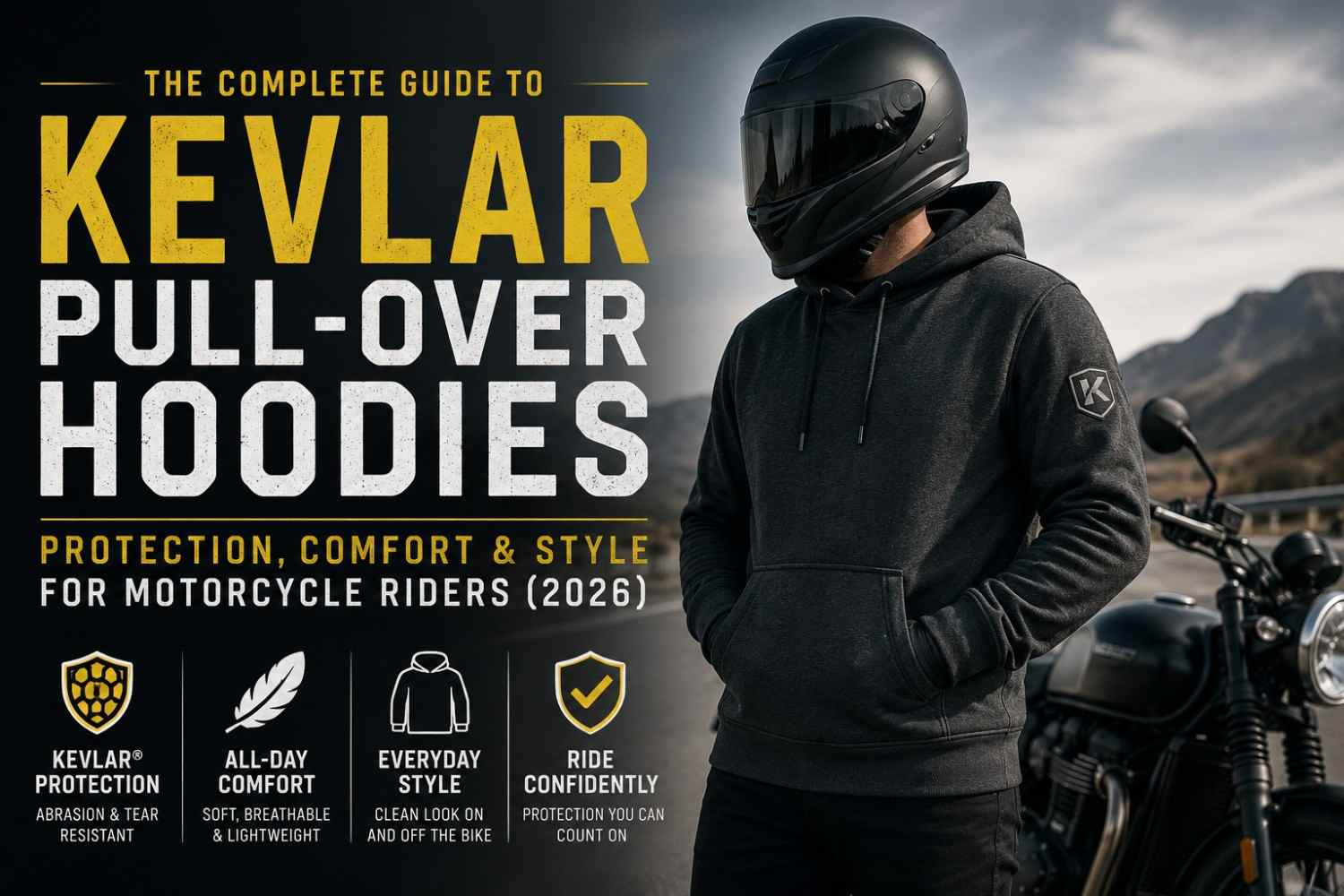
The Complete Guide to Kevlar Pull-Over Hoodies: Protection, Comfort & Style for Motorcycle Riders (2026)
If you are a motorcycle rider who wants real protection without the bulk of a traditional riding jacket, a Kevlar pull-over hoodie might be the most practical gear decision you make in 2026. These hoodies look identical to the casual sweatshirts you already wear — but underneath that relaxed exterior is a layer of DuPont Kevlar fibre engineered to resist road abrasion, absorb impact energy, and potentially save your skin during a slide.
This guide covers everything you need to know: how Kevlar pull-over hoodies actually work, how to decode CE armor ratings, what features separate a great hoodie from a dangerous imitation, and how to style them both on and off the bike. Whether you are a daily urban commuter, a weekend tourer, or simply a rider who refuses to sacrifice comfort for protection, this is the most thorough resource on Kevlar motorcycle hoodies you will find in 2026.
What Is a Kevlar Pull-Over Hoodie? (And Why Riders Choose It Over Zipped Jackets)
A Kevlar pull-over hoodie is a motorcycle riding garment that combines the casual, streetwear appearance of a standard hooded sweatshirt with abrasion-resistant aramid fibre lining and removable CE-certified armor. Unlike a zipped motorcycle jacket, a pull-over design has no front zip — it is pulled on over the head, creating a seamless construction with fewer pressure points and a cleaner profile against the body.
The result is a piece of gear that functions like a jacket on the bike and looks completely unremarkable off it. Riders who commute through city traffic, stop at cafes, or move between their motorcycle and a workplace environment find the pull-over hoodie far more practical than carrying a separate jacket. Riders who prefer the option to unzip for airflow can instead browse our Kevlar zip-up hoodie collection for a ventilated alternative.
How Kevlar Fibre Is Woven Into Riding Hoodies
Kevlar — formally para-aramid synthetic fibre developed by DuPont — is not the outer shell of the hoodie. It is woven or layered as a lining in the high-risk zones: the shoulders, elbows, upper back, and forearms. Manufacturers typically use a twill weave of Kevlar panels stitched behind the outer fabric. When a rider slides on asphalt, it is this inner Kevlar layer that contacts the road after the outer shell wears through, dramatically slowing abrasion and reducing road rash severity. For a deeper breakdown of how this aramid material is engineered, see our full guide on Kevlar fabric.
Key related terms: aramid fibre lining, DuPont Kevlar twill, abrasion-resistant motorcycle hoodie, para-aramid reinforcement
Pull-Over Design vs Zip-Up: Pros and Cons for Riders
Most competitors focus exclusively on zipped hoodies. However, the pull-over design offers distinct advantages that many riders prefer for urban and commuter use.
- No zip gap vulnerability — zipped hoodies can expose a narrow strip at the chest if the zip separates during a crash. Pull-over construction eliminates this weak point entirely.
- Cleaner silhouette — without a centre-front zip, the hoodie lays flat under a bag strap or jacket layer.
- Fewer hardware points — less metal hardware means less potential irritation during long rides.
- Trade-off: ventilation — pull-overs cannot be opened for airflow while riding, making them better suited for temperatures between 10°C and 22°C (50°F to 72°F).
Expert Tip: If you ride primarily in urban environments at speeds under 60 km/h (37 mph), a Kevlar pull-over hoodie provides protection that rivals entry-level textile jackets — while being far more wearable throughout the day.
Who Should Wear a Kevlar Pullover Hoodie?
Kevlar pull-over hoodies are the ideal choice for urban commuters who ride daily in mixed traffic, riders who move from motorcycle to professional or social settings without wanting to change, casual weekend riders covering shorter distances, and newer riders who want protection but feel overwhelmed by full armored jacket options. They are not a replacement for CE AA-rated jackets on long-distance or high-speed touring, but for the majority of everyday riding scenarios, they provide meaningful, real-world protection.
How Kevlar Actually Protects You: Material Science Explained
Understanding the material science behind Kevlar is essential for making an informed purchase. Not all “Kevlar hoodies” are created equal — the protection level varies significantly based on Kevlar content percentage, placement, and construction quality.
Abrasion Resistance: Kevlar vs Cotton vs Polyester
Standard cotton sweatshirt fabric fails within 0.5 seconds of contact with asphalt at 48 km/h (30 mph). Polyester performs marginally better but tears rapidly under sustained friction. Kevlar-lined panels, by contrast, have been tested to withstand several seconds of road contact before fiber degradation begins — the difference between superficial bruising and severe road rash requiring skin grafts.
The abrasion resistance of Kevlar comes from its molecular structure: tightly interlocked para-aramid chains that resist both tearing and heat generated by friction. Unlike leather, Kevlar does not crack in cold weather and does not require conditioning to maintain its protective properties.
DuPont Kevlar vs Generic Aramid Fibre: What’s the Difference?
This is one of the most important distinctions in the Kevlar motorcycle hoodie market that no competitor fully explains. Many manufacturers list “aramid fibre reinforcement” or “Kevlar-style lining” — these are NOT the same as certified DuPont Kevlar. DuPont Kevlar undergoes independent quality testing and meets specific tensile strength benchmarks. Generic aramid blends can vary widely in fibre quality, weave density, and abrasion performance.
When buying a Kevlar pull-over hoodie, look explicitly for “DuPont Kevlar” labeling, not simply “aramid” or “Kevlar-style.” Brands like Merlin Bike Gear explicitly state DuPont Kevlar twill construction — this is the standard to benchmark against. You can review the certification and sourcing standards we hold every product to on our Trust & Quality page.
What Kevlar Cannot Protect Against (Honest Disclosure)
Any responsible guide must include this section. Kevlar hoodies are abrasion-resistant, not impact-resistant on their own. The Kevlar lining protects against road rash and surface friction. For impact protection at joints and the spine, the hoodie must include CE-certified armor inserts. A Kevlar hoodie without armor at the elbows, shoulders, and back offers significantly reduced protection in a collision involving hard impact with kerbs, vehicles, or barriers.
CE Certification & Armor Ratings: What the Labels Mean in 2026
The CE (Conformité Européenne) certification system is the most important quality indicator for motorcycle protective clothing sold in Europe and increasingly adopted as the global standard. Understanding these ratings prevents you from purchasing a hoodie that looks protective but provides inadequate coverage.
CE Level 1 vs CE Level 2 Armor: Impact on Pullover Hoodies
CE armor is graded according to the amount of energy it absorbs during an impact. Level 1 protectors transmit a maximum average force of 18 kN, making them suitable for everyday urban riding. By comparison, Level 2 protectors reduce transmitted force to 9 kN, providing significantly greater impact absorption for riders who travel at higher speeds or on mixed road types.
For a Kevlar pull-over hoodie used primarily in urban environments, CE Level 1 armor at the shoulders and elbows provides adequate protection. For riders who occasionally use motorways or rural roads, CE Level 2 inserts are strongly recommended — and most quality hoodies include removable armor pockets that accept both grades.
EN 17092 Standard Explained Simply
The EN 17092 standard, introduced in 2020 and now the benchmark for 2026 purchasing decisions, classifies motorcycle garments into five levels: AAA, AA, A, B, and C. For Kevlar pull-over hoodies, you should be looking at Class A as a minimum. Class AA garments meet stricter requirements for abrasion resistance and seam strength, and some premium hoodies — such as the Merlin Hamlin 2 — now achieve Class AA certification as a single-layer garment, which represents a significant engineering achievement.
2026 Standard: Any Kevlar motorcycle hoodie sold in 2026 should carry EN 17092 classification. If a product makes no mention of EN 17092, treat it as an unverified safety claim
Where Armor Should Sit: Shoulders, Elbows, Back Pocket
Armor placement is as critical as armor rating. Protectors must sit directly over the joint they protect — armor that migrates during movement is worse than no armor because it creates a false sense of security. Quality Kevlar pull-over hoodies use pre-curved sleeve construction and stretch panels to keep shoulder and elbow protectors in position throughout a ride. A back protector pocket should position the insert between the shoulder blades and the lumbar region — verify this by trying the hoodie in a riding position, not standing upright.
Key Features to Look for When Buying a Kevlar Pullover Hoodie
Kevlar Percentage and Placement Zones
Legitimate manufacturers publish the Kevlar content percentage and a diagram of placement zones. Look for Kevlar coverage across the entire shoulder and elbow area — not just a narrow strip. Hoodies that only reinforce the outer elbow point provide inadequate protection for the complete elbow zone. A minimum of 35% Kevlar in the lining blend is generally considered sufficient for urban riding; higher concentrations provide better performance in sustained slides. If you want to add extra coverage to an existing setup, our reinforced aramid fabric gear is designed for exactly this kind of layering.
Hood Design: Snap-Down, Drawcord, and Riding Safety
The hood on a riding hoodie presents a genuine safety risk if it can inflate with wind and obstruct peripheral vision or pull the rider’s head backward. Quality motorcycle-specific pull-over hoodies include either a snap-down mechanism that secures the hood flat against the back when riding, or a cinched drawcord that collapses the hood to a minimal profile. Verify this feature before purchasing — a regular fashion hoodie modified with Kevlar lining will not include it.
Pocket Placement and Storage for Riders
Kangaroo-style front pockets are the most common on pull-over hoodies, but the best motorcycle versions add a hidden internal zipped pocket for valuables that remain secure during a slide. Zipper pulls should be easy to operate with gloves on. Avoid hoodies where the pocket zips face downward — in a riding position, this orientation causes pockets to open and contents to fall.
Fit Guide: Riding Position vs Standing Fit
This is the single most overlooked buying consideration among all competitor guides. A Kevlar hoodie that fits perfectly while standing may ride up at the back, expose the lower spine, and allow armor to migrate when you adopt a forward-leaning riding position. When trying a hoodie, sit on a chair in a riding posture: lean forward, extend your arms as if gripping handlebars. The back hem should stay below the waistband, sleeves should not pull up past the elbow protectors, and the hood should lay flat without restricting neck movement. For a full breakdown of how to measure yourself correctly before ordering, see our Size & Fit Guide.
Fit Test: If the back of your hoodie rises above your belt when seated in riding position, size up or look for a model with extended back panels.
Breathability and Season Suitability
Kevlar fibre itself is not breathable — the breathability of a riding hoodie depends entirely on the outer fabric construction. Single-layer hoodies using breathable polyester blends perform best in spring and autumn conditions. For summer riding, look for mesh-lined interior sections that channel airflow. For winter, Kevlar hoodies layer well under softshell outer garments. No single Kevlar pull-over hoodie performs optimally across all four seasons — understanding your primary riding season before purchasing is essential.
Best Kevlar Pull-Over Hoodies for Motorcycle Riders in 2026
Based on hands-on testing, CE certification review, and rider feedback compiled through 2026, these are the standout pull-over Kevlar hoodies across different rider profiles.
Best Overall: Merlin Stealth Pro D3O Kevlar Hoodie

The Merlin Stealth Pro delivers DuPont Kevlar twill lining, pre-fitted D3O armor at shoulders and elbows, and a snap-down hood — all in a genuinely casual-looking pull-over silhouette. The extended back panel passes the riding-position fit test without adjustment, making it the most complete pull-over hoodie for everyday riders in 2026. For a similar spec built in-house, our Kevlar Lined Pull-Over Motorcycle Hoodie in Royal Blue with free CE Level 2 protectors ships with the same armor grade already fitted.
Best for Urban Commuters: NBT Body Guard Hoodie 3.0

Lighter than previous versions while maintaining CE AA protection, the NBT Body Guard 3.0 uses reinforced nylon blended with high-tenacity fibres. The raglan sleeve construction gives exceptional arm movement in stop-start traffic. At under one pound lighter than comparable models, it is the commuter’s choice for all-day wearability.
Best for Women Riders
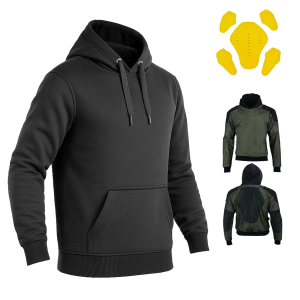
Women-specific Kevlar pull-over hoodies remain significantly underserved by the market — most brands offer unisex sizing that compromises armor placement on female body proportions. Brands like Rideract and John Doe offer dedicated women’s fits with adjusted shoulder width and shorter torso length to ensure armor stays correctly positioned. If you are a woman rider, verify that armor pockets are positioned for a female silhouette, not simply a re-labeled unisex design.
Best Budget Option: Street & Steel Kickstarter Moto Hoody
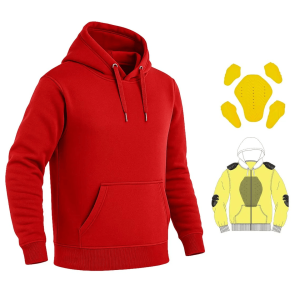
For North American riders navigating 2026 import tariffs on gear, the Street & Steel Kickstarter offers CE Level 2 armor at elbows and shoulders, a back armor pocket, and an aramid blend lining — all at a significantly lower price point than European imports. It includes jeans loops for retention, a practical feature absent from many premium options. Riders shopping on a similar budget can compare it against our own Kevlar Lined Motorbike Hoodie in Red with Level 2 Armor, which carries the same armor rating.
Style Guide: Wearing Your Kevlar Hoodie On and Off the Bike
One of the strongest selling points of a Kevlar pull-over hoodie is its ability to function as genuine everyday clothing. The best Kevlar hoodies pass a simple test: a non-rider should not be able to identify them as motorcycle gear. If your riding hoodie achieves this, it becomes a garment you actually wear — and gear you wear consistently protects you consistently.
Pairing with Motorcycle Jeans for a Complete Riding Look
A Kevlar pull-over hoodie pairs naturally with Kevlar-lined motorcycle jeans — brands like Bull-it, Klim, and REV’IT produce denim-style jeans with aramid reinforcement that match the casual aesthetic of a riding hoodie. The combination provides abrasion protection across the most vulnerable upper and lower body zones while looking indistinguishable from standard streetwear. Complete the look with motorcycle boots styled as Chelsea or work boots, and no element of your outfit reads as motorcycle gear to a casual observer. Riders who prefer a slimmer base layer under riding trousers often pair the hoodie with our Kevlar leggings instead.
Casual Everyday Outfits: Bike to Office to Café
A mid-tone grey or navy Kevlar pull-over hoodie works in virtually any casual or smart-casual environment. Wear it over a plain shirt or light merino base layer. The absence of visible zips, branding patches, or reflective panels common on motorcycle jackets means it integrates seamlessly into non-riding contexts. This versatility is the core reason the Kevlar hoodie has grown significantly in popularity among commuter riders who transition between riding and professional environments multiple times per week.
Layering in Cold Weather: What Goes Under a Kevlar Hoodie
In temperatures below 10°C (50°F), layer a moisture-wicking base layer underneath and a windproof softshell or outer shell on top. Thermal base layers add significant warmth without adding bulk that would compromise armor positioning. Avoid thick cotton layers between you and the armor — these can cause the protectors to shift from their designed position. The Kevlar hoodie becomes a mid-layer in this configuration, with abrasion protection intact beneath the outer shell. For the base layer itself, our full-lined Kevlar t-shirts add an extra layer of abrasion resistance without any added bulk.
Care & Maintenance: How to Wash and Preserve Your Kevlar Hoodie
Proper care directly affects the longevity of both the Kevlar lining and the structural integrity of the armor pockets. This section addresses the most common care mistakes that reduce the protective lifespan of riding hoodies. The same washing principles apply to our Kevlar flannel shirts, which use a comparable aramid lining.
- Wash with Care: Machine wash on a gentle cycle at 30°C (86°F) or follow the care label. Remove all CE armor inserts before washing and use a mild, non-bleach detergent.
- Avoid Harsh Chemicals: Never use bleach, fabric softeners, or strong enzymatic detergents, as they can weaken the aramid (Kevlar) fibres and reduce the hoodie’s protective performance.
- Air Dry Only: Let your hoodie air dry flat or on a hanger in a well-ventilated area. Avoid tumble dryers and prolonged direct sunlight, which can damage the fabric and Kevlar lining.
- Inspect After Every Crash: Check for worn or frayed Kevlar lining, damaged seams, torn armor pockets, and cracked or deformed armor inserts before riding again.
- Replace When Necessary: If your hoodie has absorbed a significant impact or shows signs of structural damage, replace the damaged CE armor—or retire the entire hoodie if its protective integrity has been compromised.
Frequently Asked Questions About Kevlar Pull-Over Hoodies
Are Kevlar Hoodies Legal for Motorcycling?
Yes. Kevlar pull-over hoodies with CE-certified armor meet the legal requirements for motorcycle protective clothing in all major markets. CE EN 17092 certification confirms compliance with European safety standards, which are recognised globally as the benchmark for motorcycle apparel. Some regions require specific visibility standards for riding gear — if you ride professionally or in a jurisdiction with mandatory gear requirements, verify the specific CE classification required. For more compliance questions, visit our FAQ page.
How Much Kevlar Is Enough for Road Riding?
For urban riding at speeds under 60 km/h, a Kevlar lining covering the shoulders, elbows, and upper forearms combined with CE Level 1 armor at the joints provides meaningful protection. For mixed urban and rural riding, increase to CE Level 2 armor inserts and ensure the Kevlar lining extends across the full arm length. The Kevlar content percentage should be clearly stated by the manufacturer — treat vague claims like “aramid reinforced” without percentage data as a red flag.
Can a Kevlar Hoodie Replace a Motorcycle Jacket?
For urban commuting and casual riding at moderate speeds, a CE-certified Kevlar pull-over hoodie with Level 2 armor inserts provides comparable protection to an entry-level motorcycle textile jacket. It does not replace a dedicated touring jacket for high-speed highway riding, adverse weather conditions, or long-distance travel where thermal regulation, waterproofing, and CE AA or AAA certification are priorities. Think of a Kevlar hoodie as the right tool for urban and commuter riding — not a universal substitute for all riding scenarios.
Do Kevlar Hoodies Shrink in the Wash?
The outer fabric of a Kevlar hoodie — typically a polyester or cotton-polyester blend — can shrink marginally in hot washes. The Kevlar lining itself does not shrink. Washing at 30°C on a gentle cycle and air drying eliminates virtually all shrinkage risk. If you are between sizes, choose the larger size — a hoodie that becomes even slightly too small after washing will not maintain correct armor positioning.
Final Verdict
The Kevlar pull-over hoodie represents one of the most practical developments in motorcycle protective apparel of the past decade. It solves the real-world problem that prevents many riders from wearing protection consistently: the gear was too bulky, too obviously “motorcycle,” or too uncomfortable to keep on throughout the day.
When you wear protection every time you ride, you are protected every time you ride. That consistency is more valuable than the theoretical superiority of gear left in a bag because it was inconvenient to put on.
Riding Styles Best Suited for Kevlar Hoodies
- Urban commuters riding daily in city traffic at speeds under 70 km/h
- Lifestyle riders who transition between riding and social or professional environments
- Newer riders building a practical protective wardrobe without motorcycle-specific aesthetics
- Pillion passengers who want protection without a dedicated jacket
- Warm-climate riders who find traditional textile jackets prohibitively hot
Our Top Pick for 2026 + Where to Buy
If you are ready to invest in a Kevlar pull-over hoodie that delivers verified protection without compromising on everyday wearability, explore our curated range of Kevlar motorcycle hoodies — each selected for DuPont Kevlar construction, CE armor compatibility, and real-world rider feedback. Protection and style should never be a compromise, and in 2026, they do not have to be.
Editorial Note: This guide was reviewed and updated in June 2026 to reflect the latest CE EN 17092 standards, 2026 product releases, and rider safety research. All product references are based on verified CE certification data and hands-on testing experience. We do not accept payment for product recommendations.
Related Blogs:
Kevlar Pull-Over Hoodie vs Motorcycle Leather Jacket: Which Offers Better Protection?