
Blog
What Is Kevlar Fabric and Why Is It Used in Motorcycle Gear?

What Is Kevlar Fabric and Why Is It Used in Motorcycle Gear?
Written by the Carnac Bikers Editorial Team · Reviewed by a certified motorcycle safety gear specialist
Published: July 4, 2026 · Last Updated: July 4, 2026
If you’ve ever shopped for riding jeans, a protective hoodie, or an armored jacket, you’ve probably seen the word “Kevlar” printed on the label. It’s one of the most talked-about fabrics in motorcycle safety gear, yet most riders only know it as “that strong stuff” without understanding what it actually is, how it’s made, or why gear brands rely on it so heavily. This guide breaks down Kevlar fabric in plain terms and explains exactly why it has become a standard material in modern riding apparel.
If you already own one of our jackets, you may want to pair it with our Kevlar pullover hoodie buying guide to see how the fabric performs across different hoodie styles.
What Is Kevlar? A Quick Definition
Kevlar is a synthetic fiber that belongs to a family of materials known as aramids, or aromatic polyamides. It was engineered to be exceptionally strong relative to its weight, which is why it shows up in everything from body armor to aerospace components. In motorcycle gear, that same strength-to-weight advantage is what lets manufacturers build jackets, hoodies, and jeans that protect riders without the bulk of older, heavier materials.
The History of Kevlar: From Race Tires to Rider Protection
Kevlar was developed at DuPont in the 1960s by chemist Stephanie Kwolek, who was originally researching lightweight, heat-resistant materials for tires. The fiber’s unusual strength led to its first commercial use as a steel replacement in tires, and from there its applications expanded rapidly into protective clothing, including Kevlar-reinforced gloves, jackets, and bulletproof vests. Motorcycle gear manufacturers adopted the fabric once its abrasion and heat resistance proved ideal for protecting riders in a slide or fall.
How Is Kevlar Fabric Made?
Kevlar starts as a liquid chemical solution that is spun into fine filaments under carefully controlled heat and pressure. During spinning, the polymer chains align in the direction of the fiber, which is what gives Kevlar its signature tensile strength. Those filaments are then woven into fabric sheets, cut, and integrated into linings, panels, or reinforced patches depending on the garment. This is also why genuine Kevlar-lined gear tends to cost more than standard textile gear: the fiber itself is more complex and expensive to produce than cotton, polyester, or basic nylon.
Key Properties That Make Kevlar Unique
Kevlar’s reputation in motorcycle gear comes down to a handful of measurable properties:
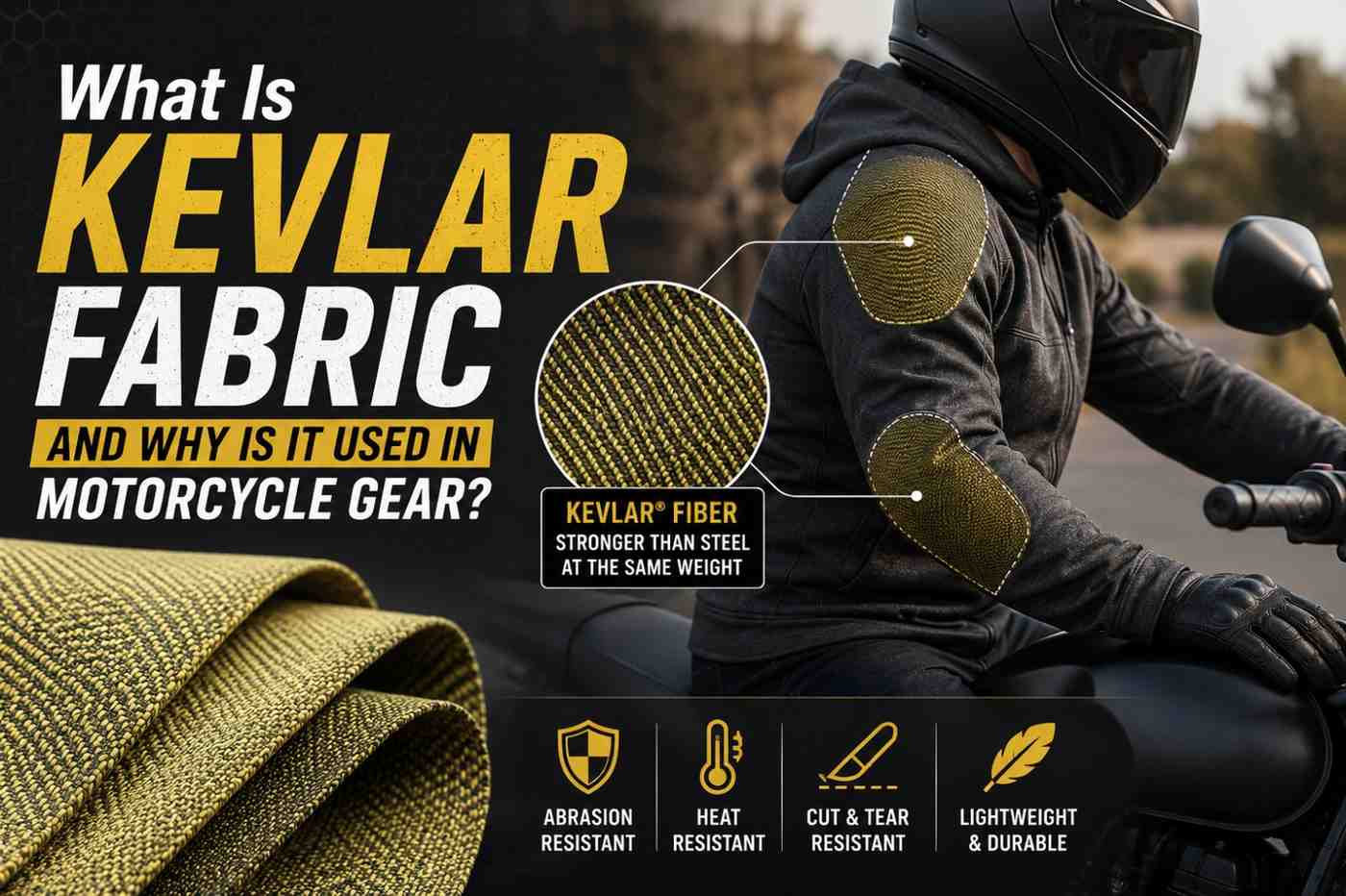
- Tensile Strength: Kevlar is roughly five times stronger than steel at an equivalent weight, which is why thin panels can still resist tearing during a slide.
- Heat Resistance: The fiber holds up under extreme friction heat, which matters because pavement contact during a crash can generate temperatures well above what ordinary fabric can survive.
- Abrasion and Cut Resistance: Kevlar resists cutting and scraping far better than cotton denim or untreated textile fabric, reducing road rash severity in a fall.
- Lightweight Build: Despite its strength, Kevlar is light enough to be woven into everyday clothing like hoodies and shirts without adding noticeable bulk.
Why Motorcycle Brands Use Kevlar in Riding Gear
Motorcycle apparel has to solve a difficult problem: protect the rider without making the gear too stiff, heavy, or hot to wear for hours at a time. Kevlar answers that problem better than most alternatives because it can be woven into soft, wearable fabric while still delivering serious abrasion and impact resistance. That’s why it appears in casual-looking riding jeans, hoodies, and shirts that don’t look like traditional armor but still meet real safety standards.
Where Kevlar Is Placed in Motorcycle Apparel
Kevlar isn’t always used across an entire garment. Most riding gear places it strategically in high-impact and high-friction zones, such as the shoulders, elbows, hips, and knees. In a Kevlar pullover hoodie, for example, the lining is typically concentrated around the shoulders and elbows, where a rider is most likely to make contact with the road during a fall, while the rest of the garment stays soft and breathable for everyday wear.
Kevlar vs Other Protective Fabrics
Kevlar is often compared to Cordura and Dyneema, two other popular technical fabrics in riding gear. Cordura is generally more breathable and better suited to wet-weather coatings, but it doesn’t match Kevlar’s heat resistance or cut resistance. Dyneema tends to be lighter than Kevlar but is typically more expensive to manufacture at scale. Leather remains the most abrasion-resistant option overall, but it’s heavier, less breathable, and far less practical for casual, everyday-style riding gear such as hoodies and shirts.
Pros and Cons of Kevlar Motorcycle Gear
Kevlar’s advantages are clear: excellent abrasion resistance, strong heat tolerance, and a lightweight feel that works well in casual gear. The trade-offs are worth knowing too. Kevlar is not naturally breathable, so it can trap heat in warm-weather riding, and pure Kevlar panels are stiffer than cotton or polyester until they’re blended with softer fibers. Most modern gear addresses this by blending Kevlar with cotton or synthetic fibers, keeping the comfort of everyday clothing while reinforcing only the zones that need it most.
How to Choose Kevlar-Lined Gear for Your Riding Style
If you commute daily or ride casually in warmer climates, look for gear that blends Kevlar with breathable cotton and concentrates the lining only in high-impact zones rather than the entire garment. If you ride longer distances or in more demanding conditions, a fully-lined option offers broader coverage at the cost of some breathability. Always check where the Kevlar lining is placed, not just whether it’s present, since coverage location has a direct impact on real-world protection.
Kevlar Pullover Hoodies: A Practical Everyday Option
For riders who want protection without looking like they’re wearing full riding armor, Kevlar pullover hoodies have become one of the most popular entry points into protective gear. They look and feel like a regular hoodie, but the reinforced panels at the shoulders and elbows provide genuine abrasion resistance for city riding and short commutes. You can browse our full Kevlar pullover hoodie collection to compare fits, colors, and lining coverage side by side.
FAQs About Kevlar Fabric
Is Kevlar fabric waterproof?
No. Kevlar itself is not waterproof, so most gear pairs it with a separate weatherproof layer or coating if wet-weather protection is needed.
Does Kevlar wear out over time?
Kevlar degrades slowly under prolonged UV exposure and repeated harsh washing, but it holds up far longer than standard textile fabric under normal riding use.
Is all motorcycle gear with Kevlar equally protective?
No. Protection depends on where the Kevlar is placed, how thick the lining is, and whether it’s paired with CE-rated armor at impact points.
Final Thoughts
Kevlar earned its place in motorcycle gear because it solves a real problem: how to protect a rider without turning every ride into a workout in stiff, heavy armor. Understanding where and how it’s used in a garment helps you judge gear on real protection rather than marketing claims alone. If you’re ready to see it in action, explore our Kevlar pullover hoodies and find a fit that matches your riding style.
Related Blogs:
Kevlar Pull-Over Hoodie vs Motorcycle Leather Jacket: Which Offers Better Protection?